What Causes Yellow or Brown Stains on a White Ceiling — and Whether Paint Can Fix It
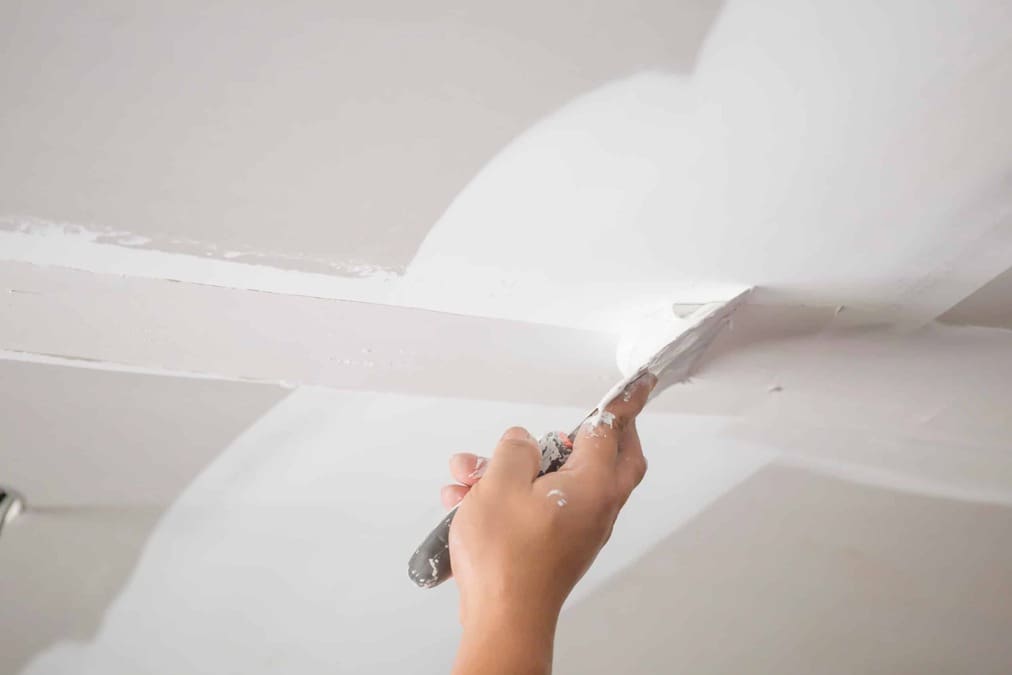
There is a specific moment most homeowners in Mooresville, Cornelius, Davidson, Denver, and across the Lake Norman area have experienced: you look up at what used to be a uniformly white ceiling and notice it — a yellowish ring, a brown discoloration, a spreading stain that wasn’t there last year. Sometimes it appears after a storm. Sometimes it shows up gradually, almost imperceptibly, over a season. Sometimes you painted over it eighteen months ago and it’s back, slightly darker and slightly larger than before.
The instinct in most of these situations is to grab a can of white ceiling paint and cover the stain. Sometimes that works. More often it doesn’t — the stain reappears through the fresh paint within weeks or months, looking almost as dark as before, sometimes darker, because the water-soluble compounds that create the stain have migrated upward through the wet paint film and deposited themselves at the new surface as the moisture evaporated. You’ve added a coat of paint and solved nothing, because the stain wasn’t a paint problem. It was a symptom of something else, and paint alone cannot treat a symptom without addressing the cause.
Understanding what different ceiling stains actually indicate, how to tell them apart, and what the correct treatment sequence is for each type is what determines whether you paint over a stain and forget about it for a decade or paint over it and watch it return before the paint has finished curing.
The Anatomy of a Ceiling Stain: What’s Actually in That Discoloration
Every yellow or brown ceiling stain is a deposit of something that traveled to the ceiling surface carried in water and left behind when the water evaporated. The specific chemistry of what was dissolved in that water determines the color, the pattern, the bleed-through behavior, and the treatment required.
Water stains from roof leaks or plumbing events carry dissolved minerals from the water itself — calcium, magnesium, iron — along with tannins and organic compounds from wood framing, insulation, and drywall paper that the water contacted during its journey to the ceiling surface. These mineral and organic deposits are what create the characteristic ring pattern of a typical water stain: as the water spreads outward and evaporates from the edges of the wet area first, it concentrates the dissolved solids at the perimeter, producing the darkened ring that marks the boundary of where moisture traveled. The center of the stain is often lighter than the ring, which is one of the visual signatures that identifies a water stain specifically.
The yellow to brown color range of water stains depends on what was dissolved. Iron in the water produces distinctly orange-brown staining. Tannins from wood produce yellow to medium brown. Mineral deposits alone tend toward a pale, chalky off-white. Most ceiling water stains show some combination of these compounds, which is why they rarely look exactly the same from house to house even when caused by similar events.
Roof Leak Stains vs. Plumbing Leak Stains: Reading the Location
Before doing anything to address a ceiling stain, the most important step is identifying where the moisture came from — because the treatment for a symptom that is still actively receiving new moisture is entirely different from the treatment for a stain left by a resolved leak. Painting over an active moisture source, however well-executed the stain-blocking primer and topcoat application, produces a stain that returns because the moisture is still arriving.
Roof leak stains in Lake Norman homes follow predictable patterns based on the roof’s geometry and the failure points that North Carolina’s weather tends to produce. Stains that appear near the peak of a vaulted ceiling or near a chimney penetration after heavy rain typically indicate flashing failure — the metal barriers that direct water away from these transitions have shifted, corroded, or lost adhesion, and bulk water is entering the attic during rain events and traveling down to the ceiling drywall. Stains that appear at the eave line or in the upper corners of rooms after ice accumulation on the roof indicate ice dam events, where water backed up behind frozen gutters has penetrated under shingles. Stains that appear in multiple locations across a ceiling after a particularly heavy storm often indicate wind-driven rain entering at ridge vents or gable vents rather than a roofing failure per se.
Plumbing leak stains present differently. They tend to appear on first-floor ceilings below bathrooms, kitchens, or laundry rooms on the floor above, and they often show a more concentrated central stain without a pronounced ring, because the water dripped consistently from a point source rather than spreading laterally as a roof leak would. The stain may be accompanied by a subtle sagging or soft spot in the drywall if the leak was significant and prolonged. In Lake Norman homes with second-floor bathrooms — which describes a large portion of the newer construction in Mooresville, Cornelius, and Davidson — toilet supply line connections, shower pan failures, and drain fitting leaks are the most common plumbing sources of first-floor ceiling staining.
Smoke and Grease Stains: The Ones That Look Like Water But Aren’t
Not every yellow or brown ceiling stain comes from water. Two other sources produce similar coloration through entirely different mechanisms, and misidentifying them leads to the wrong treatment.
Smoke staining — from fireplace backdraft, candle combustion, cooking smoke, or previous occupants who smoked indoors — produces a yellowish to brownish discoloration on ceilings that is often more diffuse and uniform than a water stain ring pattern. Smoke staining tends to affect larger areas rather than discrete spots, often concentrating near light fixtures where the heat convection draws air upward and deposits combustion particles. In Lake Norman homes with wood-burning fireplaces — common in the area’s older and more traditional construction — periodic backdraft events deposit a subtle smoke film on ceiling surfaces near the fireplace that accumulates over years into visible yellowing.
Cooking grease staining in kitchen ceiling areas produces a similar diffuse yellowing that is often most visible directly above the cooking surface and adjacent to range hood locations. In homes where range hoods vent internally rather than to the exterior, airborne cooking grease deposits on every surface in the kitchen including the ceiling, and these deposits oxidize over time into the yellow-brown discoloration that homeowners assume is aging paint rather than identifying correctly as grease contamination.
The diagnostic difference between water stains and smoke or grease stains matters for treatment because their chemistry requires different blocking approaches. Shellac-based stain blockers handle both effectively, but water stains and smoke stains can sometimes be addressed with quality oil-based primers where grease staining specifically may require a degreasing step before any primer goes on, because an active grease film on the surface will prevent primer adhesion just as it prevents paint adhesion.
Why Standard Ceiling Paint Fails to Cover Stains — The Bleed-Through Mechanism
Understanding why regular ceiling paint doesn’t cover stains, even in multiple coats, is what makes the correct treatment sequence make sense rather than seeming like an unnecessary extra step.
The compounds that create yellow and brown ceiling stains — mineral salts, tannins, smoke residues, and oxidized grease — are water-soluble or oil-soluble in ways that interact predictably with latex paint. When standard latex ceiling paint is applied over these compounds, the water in the wet paint dissolves them and they become mobile, migrating upward through the paint film as the water evaporates during drying. They deposit at the surface of the new paint film as the moisture leaves, producing the stain pattern that reappears at the surface of a fresh coat. Adding more latex coats compounds the problem by adding more water to dissolve and redistribute the staining compounds rather than blocking them.
The solution is a primer specifically formulated to chemically seal these compounds in place rather than dissolving and redistributing them. Shellac-based primers — traditional oil-based formulations that cure through solvent evaporation rather than water evaporation — create a film that is impermeable to the water-soluble staining compounds, sealing them against the surface beneath rather than allowing them to migrate. One coat of shellac-based primer over a properly dried and repaired stain location creates a foundation that two coats of latex ceiling paint can be applied over without bleed-through. The shellac step is not optional or a premium add-on — it is the step that determines whether any amount of subsequent paint work actually holds.
Oil-based stain-blocking primers serve a similar function and are the appropriate alternative for homeowners or contractors who prefer not to work with shellac. Quality latex stain blockers at the high end of the market can address light to moderate staining, but for the brown ring stains that indicate significant water infiltration — particularly in Lake Norman homes where summer humidity ensures that any water that entered a wall cavity took time to dry and had ample contact with wood framing and insulation — shellac or oil-based blocking is the more reliable choice.
The Repair Sequence That Actually Works
Properly treating a yellow or brown ceiling stain in a Lake Norman home follows a specific sequence that builds on each prior step. Skipping any step produces a result that either fails to hide the stain or hides it temporarily before bleed-through returns.
The sequence begins with confirming the moisture source has been resolved. This is the step that most homeowners skip in the interest of speed, and it is the one that determines whether the treatment is permanent or temporary. If the stain appeared after a verifiable one-time event — a specific storm that has since been addressed with a roof repair, a supply line that has been replaced — and the ceiling has been dry for at least two to four weeks with no recurrence of the stain, it is reasonable to proceed with treatment. If the stain is of unknown origin or has appeared without a resolved cause, proceeding with painting produces a result that will be undone by the next moisture event.
With a confirmed dry and resolved moisture source, the affected drywall should be evaluated for structural integrity — pressing lightly on the surface to check for softness, checking whether the paper facing has separated from the gypsum core, and examining whether the drywall has sagged or deformed. Significant water damage to drywall requires replacement of the affected section before painting, because damaged drywall will not hold paint securely regardless of the stain blocking primer applied over it.
After confirming the drywall is sound, one full coat of shellac-based stain-blocking primer — applied with a brush to cut in the perimeter of the stain and rolled over the central area — seals the staining compounds against the surface. Allow complete drying according to the product’s specified dry time, which for shellac products is typically forty-five minutes to one hour. Two coats of quality flat ceiling paint complete the repair. The result is a stain-free surface that does not return as long as the moisture source that created it has been genuinely resolved.
Let our team Handle the Diagnosis and the Fix
Ceiling stains are one of those paint problems where applying the right material in the right sequence produces a permanent fix, and applying the wrong material — or the right material in the wrong sequence — produces a result that comes back before the paint has fully cured. At Trailblaze Paints, we help homeowners throughout Mooresville, Cornelius, Davidson, Denver, Sherrills Ford, and the Lake Norman area identify what caused the stain, confirm the moisture source has been resolved, and execute the primer and paint sequence that actually holds. Whether you’re dealing with a post-storm water ring, a slow-developing plumbing stain, or a diffuse yellowing from years of smoke or cooking residue, we’re ready to assess the situation honestly and deliver an interior paint job that looks clean and stays that way. Contact our team today to get your free estimate — and let’s take care of that ceiling the right way, from the first step to the last coat.